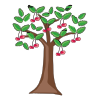
Cherry trees are elegant, deciduous trees admired for their spectacular spring blossoms and delicious fruit. In early spring, they burst into clouds of delicate white or pale pink flowers that smother the bare branches, attracting bees and other pollinators before a single leaf appears — making them one of the most visually striking features of any garden or orchard.
As the season progresses, the flowers give way to clusters of glossy cherries ranging in colour from bright yellow and red to deep burgundy or near-black, depending on the variety. Sweet cherries (Prunus avium) are eaten fresh from the tree, while sour or acid cherries (Prunus cerasus) are prized for cooking, baking, and preserving.
Cherry trees develop a graceful, often spreading form with attractive, smooth bark that adds winter interest. They thrive in temperate climates with a distinct cool period, requiring well-drained soil and a sunny position to perform at their best. Many sweet cherry varieties require a compatible pollination partner nearby, while sour cherries are typically self-fertile.
With careful siting, pruning, and pest management, cherry trees can be productive for many decades. Whether grown as a standard tree, trained against a wall, or kept compact on a dwarfing rootstock, they reward the patient gardener with an annual harvest of fruit that is difficult to match for freshness and flavour.
How To Grow
How to Grow Cherry Trees
1. Choose the Right Variety
Select a variety suited to your local conditions and intended use. Sweet cherries (Prunus avium) produce fruit best eaten fresh but usually require a compatible pollination partner. Sour/acid cherries (Prunus cerasus), such as Morello, are self-fertile and better suited to cooler, shadier conditions. Consider the rootstock — dwarfing rootstocks keep trees compact and manageable, while more vigorous rootstocks suit open orchards.
2. Choose the Right Location
- Plant in full sun with at least 6–8 hours of direct light daily.
- Choose a site with good air circulation to reduce fungal disease risk.
- Avoid frost pockets — late spring frosts can destroy the blossom and eliminate an entire year's crop.
- A warm, sheltered wall is ideal for sweet cherries in marginal climates.
3. Soil Preparation
- Cherry trees require well-drained, fertile soil. They will not tolerate waterlogging.
- Ideal pH is 6.0–7.0.
- Improve heavy or compacted soil with grit and organic matter before planting.
4. Planting
- Plant bare-root trees during the dormant season (late autumn to early spring).
- Container-grown trees can be planted at any time of year, but avoid periods of drought or hard frost.
- Dig a hole twice as wide as the root system and at the same depth.
- Ensure the graft union sits above soil level.
- Backfill, firm gently, stake the tree, and water in thoroughly.
- Apply a mulch of compost or wood chip around the base, keeping it clear of the trunk.
5. Watering
- Water regularly during the first year while the tree establishes.
- Once established, water during prolonged dry spells, particularly when fruit is swelling.
- Inconsistent watering can cause fruit to split.
6. Feeding
- Apply a balanced fertiliser or well-rotted compost in early spring.
- Avoid excessive nitrogen, which promotes leafy growth at the expense of fruit.
- A high-potassium feed in spring can improve fruit quality.
7. Pruning
- Prune sweet cherries in mid- to late summer to reduce the risk of silver leaf and bacterial canker infections, which enter through pruning wounds in wet weather.
- Sour cherries can be pruned in spring after blossom.
- Remove dead, diseased, or crossing branches.
- Maintain an open, well-ventilated canopy.
8. Pollination
- If growing sweet cherries, ensure you have a compatible pollination partner nearby, or choose a self-fertile variety.
- Sour cherries are generally self-fertile.
9. Protection
- Net the tree as fruit ripens to prevent birds from stripping the entire crop.
- Protect spring blossom from late frosts with fleece if necessary.
With good care, cherry trees can live and fruit productively for many decades.
Harvesting
Harvesting Cherries
When to Harvest
Cherries do not ripen after picking, so it is essential to wait until they are fully ripe before harvesting. A ripe cherry will be:
- Fully and evenly coloured for the variety (bright red, deep red, burgundy, or near-black depending on type)
- Firm but with a slight give when gently squeezed
- Sweet and juicy (sweet varieties) or fully tart and coloured (sour varieties)
Harvest season typically falls in late spring to midsummer, with exact timing varying by variety and local climate. Early varieties ripen first; late varieties extend the season by several weeks.
How to Harvest
- Pick cherries by hand, using a gentle twist-and-pull motion.
- Keep the stem attached to the fruit — this significantly extends shelf life and reduces the risk of disease entering through the attachment point.
- Avoid pulling aggressively, which can damage the fruiting spurs and reduce next year's crop.
- Pick in stages as different parts of the tree ripen at slightly different rates.
Handling
- Cherries bruise easily — handle them with care and place gently into shallow containers to avoid crushing fruit at the bottom.
- Do not overfill containers.
Best Conditions for Harvesting
- Harvest on a dry day, ideally in the morning after any dew has dried.
- Wet fruit is more prone to splitting and spoilage during storage.
Storing and Using Cherries
- Refrigerate fresh cherries as soon as possible after harvest.
- Do not wash until ready to eat or use.
- Fresh cherries keep for 3–5 days in the refrigerator.
- For longer storage, cherries can be frozen (stone in or out), dried, or used in jams, compotes, and preserves.
- Sour cherries are excellent for cooking, baking, and fermentation.
Harvesting regularly and promptly reduces the risk of overripe fruit attracting wasps, birds, and disease.
Common Problems
Common Cherry Tree Problems
Pests
- Birds — The most significant problem; they consume ripe fruit rapidly. Net the tree during fruiting to protect the crop.
- Cherry fruit fly / Cherry maggot — Larvae tunnel into fruit, causing it to rot. Use sticky traps and good sanitation to reduce populations.
- Aphids — Black cherry aphids colonise shoot tips and new leaves, causing curling and distortion. Encourage natural predators or use an appropriate insecticidal soap.
- Winter moth caterpillars — Larvae eat young leaves and flowers in spring. Grease bands on the trunk in autumn can help prevent egg-laying adults from climbing.
Diseases
- Brown rot (Monilinia spp.) — Causes fruit to shrivel and rot, often with grey fungal pustules. Remove and destroy affected fruit promptly; improve air circulation.
- Silver leaf (Chondrostereum purpureum) — Leaves develop a silvery sheen; branches die back. Prune only in dry weather (ideally mid- to late summer) to reduce infection risk. Remove and destroy affected wood.
- Bacterial canker (Pseudomonas syringae) — Causes sunken, weeping lesions on bark and shot-hole symptoms on leaves. Prune in dry summer weather and apply a copper-based fungicide in autumn.
- Cherry leaf scorch / Leaf spot — Fungal infection causing brown spots and early leaf drop. Improve airflow and remove fallen leaves.
Environmental Issues
- Fruit splitting — Heavy rain after dry periods causes rapid water uptake and fruit cracking. Mulch well and maintain consistent watering.
- Frost damage — Late spring frosts can kill open blossoms, eliminating that year's crop. Fleece or covers can help protect blossom during frost events.
- Waterlogging — Cherry trees are very sensitive to poorly drained soils, which cause root rot and general decline. Always plant in well-drained conditions.