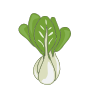
Chinese cabbage is a cool-season leafy vegetable widely grown in kitchen gardens for its crisp, mild-flavoured leaves. It encompasses several distinct types, most notably Napa cabbage (barrel-shaped, tightly packed leaves) and Bok Choy / Pak Choi (loose, spoon-shaped leaves with thick white or green stems).
Both annual and biennial forms exist, though Chinese cabbage is almost universally grown as an annual. It matures quickly — typically 50 to 100 days from sowing depending on variety — making it an excellent choice for succession planting and for filling gaps in the growing calendar.
Loose-leaf types tend to be more cold-tolerant than tight-headed varieties and can even survive light frosts. The leaves are crisp and slightly sweet when young, and are delicious eaten raw in salads or lightly cooked in stir-fries, soups, and fermented dishes such as kimchi. Chinese cabbage is one of the most widely cultivated vegetables in the world and an exceptionally productive crop for the space it occupies.
How To Grow
Growing Chinese Cabbage
Timing
Chinese cabbage is a cool-season crop that grows best when daytime temperatures are between 13–20°C. It is best sown in early spring (for a late spring harvest) or in late summer (for an autumn/fall harvest). Avoid peak summer heat, which triggers bolting — the plant sending up a flower stalk and becoming bitter and inedible.
Soil Preparation
Prepare a fertile, well-drained bed enriched with well-rotted compost or manure before planting. Aim for a soil pH of 6.0–7.5. Chinese cabbage is a hungry feeder and responds well to rich, moisture-retentive soil.
Sowing
- Sow seeds 1 cm deep, either directly into the garden bed or into small pots/trays for transplanting.
- Direct sowing is often preferable, as Chinese cabbage can be sensitive to root disturbance.
- Seeds typically germinate in 5–10 days at 10–25°C.
- Thin or transplant seedlings to 30–45 cm apart, with 45–60 cm between rows.
Watering
Keep the soil consistently moist — irregular watering causes bitterness, splitting, or bolting. Mulching around the base helps retain moisture and keep roots cool during warmer spells.
Feeding
Apply a nitrogen-rich fertiliser every 2–3 weeks to encourage lush, leafy growth. Avoid excessive nitrogen close to harvest, which can promote soft, loose heads.
Pest Management
Common pests include cabbage white butterfly caterpillars, aphids, flea beetles, and slugs. Use fine mesh netting or row covers as a physical barrier. Inspect the undersides of leaves regularly and remove pests by hand or treat with an appropriate organic spray such as neem oil.
Bolting Prevention
- Choose bolt-resistant varieties if sowing in spring.
- Provide light shade during warm periods.
- Avoid transplant shock, which can trigger early bolting.
Harvesting
Harvesting Chinese Cabbage
When to Harvest
Chinese cabbage is typically ready 60–80 days after sowing, depending on variety. For headed types (Napa), harvest when the head feels firm and compact when gently squeezed, and has reached its expected size (usually 20–45 cm tall). For loose-leaf types (Bok Choy), harvest once the plants are well-developed but before they begin to flower.
Do not leave headed varieties in the ground too long — overmature heads will split, bolt, or become bitter.
How to Harvest
- Use a sharp, clean knife or garden shears.
- For headed varieties, cut the plant at the base, just above soil level.
- Remove any discoloured or damaged outer leaves.
- For loose-leaf types, harvest individual outer leaves as needed, allowing the plant to continue producing.
Regrowth After Harvest
After cutting a headed cabbage, leaving the stump in the ground can encourage the growth of small secondary leaves, which can be harvested a few weeks later as a bonus cut.
Best Time of Day
Harvest in the early morning when leaves are plump with moisture and at their crispest.
Storage
Do not wash before storing. Wrap loosely in paper or place in a perforated bag and store in the crisper drawer of a refrigerator. Napa cabbage keeps for 2–4 weeks; Bok Choy is best used within 5–7 days.
Frost Considerations
Chinese cabbage tolerates light frosts, which can even improve flavour slightly. However, harvest all headed varieties before a hard frost (below approximately -5°C) to avoid damage.
Common Problems
Common Problems with Chinese Cabbage
Bolting (Premature Flowering)
The most common issue with Chinese cabbage. Causes: exposure to temperatures above 25°C, long days, or transplant shock. Prevention: choose bolt-resistant varieties, sow at the right season, and maintain consistent moisture. Once a plant bolts, the leaves become bitter and the head stops forming; remove and compost the plant.
Cabbage White Butterfly / Caterpillars
The caterpillars of cabbage white butterflies devour leaves and can strip plants rapidly. Solution: use fine mesh netting over plants as a physical barrier, pick off caterpillars and eggs by hand, or apply an appropriate organic biological control (e.g. Bacillus thuringiensis).
Aphids
Clusters of small insects on the undersides of leaves weaken the plant and can spread disease. Solution: blast off with a strong jet of water, encourage beneficial insects such as ladybirds, or use an insecticidal soap spray.
Flea Beetles
Tiny beetles that create small round holes in leaves, particularly on seedlings. Solution: use row covers, keep seedlings well-watered and growing vigorously, and apply diatomaceous earth around plants.
Club Root
A soilborne disease that causes swollen, distorted roots and stunted growth. Prevention: maintain soil pH above 7.0 (lime if necessary), practice a strict crop rotation of at least 4 years, and avoid introducing infected soil or plants.
Slugs and Snails
Active in cool, damp conditions — exactly when Chinese cabbage thrives. Solution: use slug traps, barriers of sharp grit, or biological nematode controls.
Tip Burn
Brown, papery leaf edges caused by calcium deficiency or irregular watering. Ensure consistent moisture and avoid high nitrogen applications late in the season.