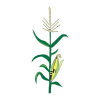
Sweetcorn is one of the most rewarding crops to grow at home, offering a flavour and sweetness that far surpasses anything available from a shop. The sugars in freshly picked corn begin converting to starch almost immediately after harvest, so eating cobs straight from the garden is a unique pleasure. Modern varieties are broadly grouped into standard, sugar-enhanced, and supersweet types, with early and mid-season varieties being the most reliable for gardens with shorter growing seasons. Plants grow tall and upright, producing one or two cobs per stem, and are wind-pollinated — making block planting essential for good pollination and well-filled cobs. Sweetcorn is a warm-season annual that needs a long, warm growing period to perform at its best.
How To Grow
Sweetcorn requires a sunny, sheltered position on fertile, well-drained soil. Because it is wind-pollinated, always plant in a square block formation rather than a single row — this ensures that pollen from tassels at the top of the plant falls onto the silks of neighbouring plants, leading to full, well-developed cobs.
Direct sowing: Sow seeds 2–3 cm deep in pairs, thinning to the strongest seedling once established. Wait until soil temperature has reached at least 10°C before sowing outdoors.
Indoor sowing: Start seeds individually in small biodegradable pots to avoid disturbing roots when transplanting. Sow 3–4 weeks before the last expected frost date. Harden off transplants carefully before moving outdoors.
Soil preparation: Incorporate plenty of well-rotted compost or manure before planting. Sweetcorn is a hungry, thirsty crop — mulching around the base helps conserve moisture and suppress weeds. Earth up around the base of stems as plants grow to improve stability.
Watering: Water consistently, especially during flowering and when cobs are swelling. Irregular watering at these stages can result in poorly filled cobs.
Harvesting
Sweetcorn cobs are ready to harvest approximately 3 weeks after the silks (the fine threads emerging from the top of each cob) first appear. As the cob approaches maturity, the silks will turn brown and dry while the husks remain green.
Checking ripeness: Peel back a small section of the outer husk and pierce a kernel with your thumbnail. A milky, creamy liquid indicates perfect ripeness — harvest immediately. A clear, watery liquid means the cob needs more time; if there is no liquid at all, the sugars have already converted to starch and the cob is past its prime.
Harvesting: Grip the cob firmly and twist it sharply downwards and away from the stem to detach it cleanly. Harvest promptly and cook or eat as soon as possible after picking — ideally within a few hours — to enjoy sweetcorn at its sweetest, before the natural sugar-to-starch conversion continues.
Second cobs: After the main cob is harvested, some varieties will produce a smaller secondary cob lower on the stem. These can also be harvested when ripe.
Season end: Complete all harvesting before the first hard frost, as plants and remaining cobs will not survive freezing temperatures.
Common Problems
Poor pollination: The most common issue — results in gaps in the cob where kernels are absent. Caused by planting in rows rather than blocks, or by very wet or dry weather during flowering. Growing in a grid of at least 4×4 plants greatly reduces this problem.
Smut fungus (Ustilago maydis): Produces large, grey, swollen galls on cobs and leaves. Remove and destroy affected material immediately — do not compost. Rotate crops to avoid recurrence.
Birds and squirrels: May strip cobs or pull up newly germinated seeds. Cover emerging seedlings with netting and protect ripening cobs if damage is observed.
Aphids: Can colonise tassels and upper leaves. Usually managed by natural predators, but heavy infestations can be reduced with a strong jet of water or an insecticidal soap spray.
Frit fly: Larvae can damage seedlings, causing distorted leaves and stunted growth. Sow seed at the correct time (when soil is warm) to reduce susceptibility. Direct-sown plants may be more vulnerable than transplants.
Waterlogging: Sweetcorn performs poorly in waterlogged soil. Ensure good drainage and avoid planting in low-lying areas prone to standing water.